
Feast Days ~ February 2026

Pope Leo’s Monthly Prayer Intention for February: For children with incurable diseases.
Let us pray that children suffering from incurable diseases and their families receive the necessary medical care and support, never losing strength and hope.
What is the Chair of St. Peter?
On February 22, we celebrate the feast day of the Chair of St. Peter. We are all familiar with Matthew 16:18 when Jesus told Peter (who was then Simon), “You are Peter, and on this rock I shall build my Church.” Thus, we celebrate St. Peter as the first Bishop of Rome and commemorate the authority of the Papacy as the teaching authority for the universal Catholic Church. This great feast day dates back to the third century. Through the Chair, we honor the mission Jesus Christ entrusted to every pope who has followed St. Peter. This Lent, why not designate a special “prayer chair” for your family to each reflect on God’s great gift of faith. You could also use this space to remember those who have died, or a family member or friend who has walked away from their faith. Let your “prayer chair” be a place of spiritual growth shaped by Jesus’ same Gospel mission entrusted to every pope.
On February 23, we celebrate the feast day of St. Polycarp, patron saint of earaches and dysentery (bowel disease). St. Polycarp was a pivotal 2nd century Christian bishop and a follower of St. John the Evangelist (Gospel writer). St. Polycarp became Bishop of Smyrna and is considered one of the Apostolic Fathers for his work developing theology in the Early Church. The Apostolic Fathers are a group of early Church theologians who directly knew the Apostles. He was martyred for his faith by being stabbed to death after miraculously surviving an attempt to burn him at the stake.
“86 years I have served Him, and He has done me no wrong. How can I blapheme my King who saved me?” St. Polycarp
On February 27, we celebrate the feast day of St. Gregory of Narek who lived at the end of the 10th century as an Armenian Abbot. The Armenian nation was the first to adopt Christianity as its official religion about 12 years before the Roman Emperor Constantine legalized Christianity in 313. Many of his literary works survive today, including commentaries on the Song of Songs and the Book of Job. He is most famously known for his mystical compilation of prayers, the Book of Lamentations, which is considered the masterpiece of Armenian literature and “an encyclopedia of prayer for all people.” The Book of Lamentations includes 95 prayers written as a long poem and discusses the pursuit of perfection and our inability to achieve it.
On February 20, we celebrate the feast day of Sts. Jacinta and Francisco Marto, Portuguese shepherd children, were two of the three children to whom our Blessed Mother appeared six times at Fatima in 1917. Blessed Mary asked the children to pray the rosary, pray for sinners, and pray for the conversion of Russia. Both siblings died soon after the apparitions from the Spanish flu pandemic. In 2017, Pope Francis canonized both children making them the youngst non-martyr saints in the Church. Pope Francis comments, “We can take as our examples Saint Francisco and Saint Jacinta, whom the Virgin Mary introduced into the immense ocean of God’s light and taught to adore Him.”
On February 21, we celebrate the feast day of St. Peter Damian, an Italian Benedictine monk and cardinal during the time of Pope Leo IX in early 1000s AD. He lost both his parents when he was young and was cared for by an older brother who treated him more like a slave. His other brother Damian, the Archbishop of Ravenna, later took him in and sent him to school for an education. In school, he was an apt student and later became a professor while constantly engaging in fasting and prayer. As a monk he was a valuable reformer in the Church and counseled many popes throughout his life including Pope Gregory VII. In 1072, he died from a fever while travelling to Rome to meet with the Pope. In 1828, St. Peter Damian was declared a Doctor of the Church.
Lent begins on Wednesday, February 18 and lasts a little over 40 days (exactly 40 days if you don’t include Sundays) until the Holy Thursday Mass depicting Jesus’ Last Supper on April 2. This is a time for all Catholics to reflect on Jesus’ Paschal mystery which is the heart of our salvation through His Passion, death, and Resurrection. During Lent, we spiritually prepare ourselves by deepening our relationship with Jesus through prayerful reflection, we examine ourselves and seek forgiveness for all our sins, and we perform penance of self-denial for the reparation of all sinners.
Fasting on Ash Wednesday and Good Friday for those aged 18 to 59, and abstaining from meat on Ash Wednesday, Good Friday, and all Fridays in Lent for those aged 14 and older, are mandatory during Lent.
Although Ash Wednesday is not a Holy Day of Obligation, it is a time we receive blessed ashes formed as a cross on our forehead to “Remember that you are dust, and to dust you shall return.”
This Lent, let’s remember to Whom we truly belong and reorder our priorities to reflect this!
Why is Easter early this year on April 5?
This is because Easter is celebrated on the first Sunday after the Paschal Full Moon which is the first full moon on or after March 21, the Church’s fixed date for the spring equinox.
February 10 is the feast day of St. Jose Sanches del Rio, patron saint of persecuted Christians. Born in Mexico on March 28, 1913, he attended Mass as often as possible from an early age. When the Cristero War began in 1926, Jose pleaded with his mother to let him join, but she refused. This widespread struggle in central and western Mexico resulted from Mexican President Calles’s attempt to limit the Catholic Church’s power and suppress Catholicism there. So instead, Jose performed menial tasks for the Cristero’s forces to stay involved. During this time, Jose was captured, tortured, and pressured to renounce his faith. When Jose continually refused, his captors forced him to walk to the cemetery where they martyred him on this day just shy of his 15th birthday.
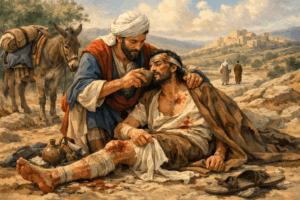
34th World Day of the Sick is on February 11 when we recall the parable of the Good Samaritan and the compassion he showed to the injured stranger by bearing the other’s pain. Pope Leo states, “We are all familiar with the moving account found in the Gospel of Saint Luke (cf. Lk 10:25-37). Jesus responds to a scholar of the law, who asks him to identify the neighbor he must love, with this story: a man traveling from Jerusalem to Jericho was attacked by robbers and left for dead. While a priest and a Levite passed him by, a Samaritan took pity on him, bandaged his wounds, took him to an inn and provided for his care. I have chosen to reflect on this biblical passage through the lens of the Encyclical Fratelli Tutti, written by my beloved predecessor Pope Francis. There, compassion and mercy towards those in need are not reduced to a merely individual effort, but are realized through relationships: with our brothers and sisters in need, with those who care for them and, ultimately, with God who gives us His love.“
Pope Leo XIV further comments, “Love is not passive; it goes out to meet the other. Being a neighbor is not determined by physical or social proximity, but by the decision to love. This is why Christians become neighbors to those who suffer, following the example of Christ, the true divine Samaritan who drew near to a wounded humanity.”
On February 11 we celebrate Our Lady of Lourdes, commemorating the 1858 apparition of Blessed Mary to 14 year old St. Bernadette Soubirous in Lourdes, France. Despite her parents’ doubts about the apparitions, Bernadette continued to visit the site because her faith was so strong. Blessed Mary, revealing herself as the Immaculate Conception, appeared to Bernadette 18 times. Blessed Mary’s message emphasized the importance of prayer, penance, and humility. In 1862, the Church confirmed the apparitions’ authenticity which continues to revitalize the faith of millions worldwide today.
“I do not promise to make you happy in this world but in the other.”- Our Lady of Lourdes to Bernadette
We celebrate Valentine’s Day on February 14 which is based on St. Valentine of Rome who is a 3rd century Roman saint and associated with courtly love. Although the Church recognizes Valentine as a saint, little factual information about him led to his removal from the General Roman Calendar. We know that he was martyred and then buried on the Via Flaminia to the north of Rome. One story that has been consistently communicated is as the former Bishop of Terni, Narnia and Amelia, he was on house arrest with Judge Asterius who had a blind daughter. The judge put his faith and the validity of Jesus to the test by challenging him to restore his child’s vision. The judge vowed to do anything for Valentine if he succeeded. Valentine succeeded in restoring her vision by placing his hands over her eyes.